


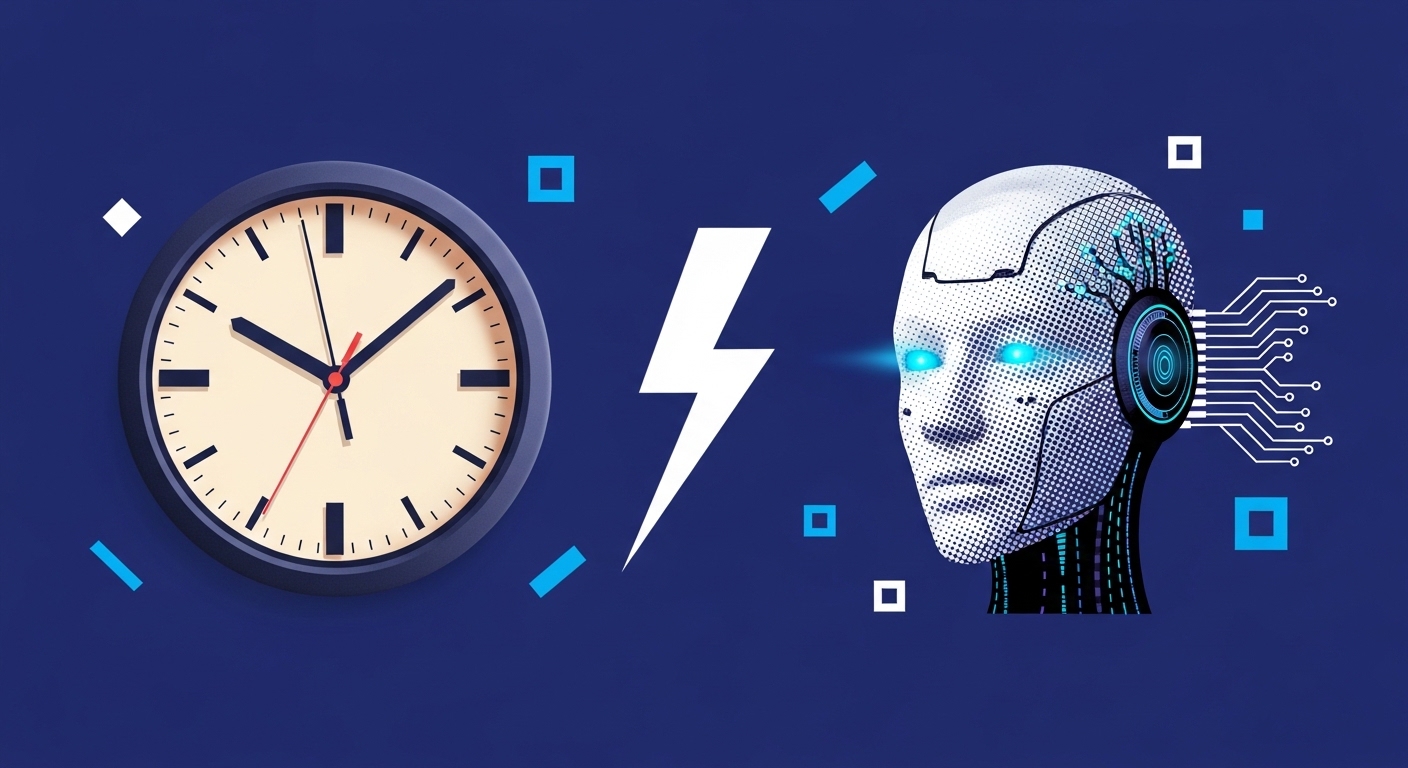
Agentic AI is transforming how engineering teams detect and resolve system failures by cutting MTTR from four hours to 15 minutes through automated root cause analysis and self-healing systems. For organisations scaling these capabilities, extended development teams with expertise in AI integration and observability are becoming essential.
Remember back in 2023 how you wait for weeks to buy those concert tickets, but when you click “Buy”, the app freezes? You refresh, but it’s too late, the tickets are gone.
A panicked IT engineer somewhere would get a phone call at 3 AM and they’d have to dig through millions of lines of code and black-and-white text files to find a single typo or a tiny server.
But it’s 2026 now. The internet has become too big, fast, and complex for humans to manage alone. Enter agentic AI; autonomous systems that can reason, investigate, and act on their own fundamentally changing the way engineering teams detect and resolve failures.
Here is the secret of how your favourite apps stay alive today, and why a new generation of agentic AI-powered “digital detectives” is the only thing standing between us and total digital chaos.
Why are Modern Apps Are So Hard to Fix?
To understand why apps break, you first have to understand that modern apps aren’t one unit. When you open an app like Instagram or Uber, you aren’t talking to one giant computer. You are talking to thousands of tiny, independent programmes called microservices that are each responsible for a specific function such as authentication, payments, or content delivery. If you want to understand how they connect, our post on building event-driven microservices covers the architecture in detail.
Think of it like a massive, global game played by thousands of hyperactive robots. One robot handles your login. Another checks your credit card. A third loads the pictures. A fourth calculates the delivery time. They are all talking to each other 24/7 in a frantic, invisible web.
The problem? They are all interconnected. When one tiny service in a data centre in Virginia “sneezes,” the whole app in London catches a cold. Because they are all so tangled together, a failure in the “Payment” section might actually be caused by a “Database” section three layers away that nobody even knew was related. Finding that one “sick” part of this mess is a nightmare.
Why are System Failures So Hard to Diagnose and How Long do they Really Take?
Imagine trying to find a single needle in a huge haystack and the whole thing is on fire. That is what a system crash feels like for engineers today.
A single click on your phone can trigger hundreds of mini-conversations between different servers. If a payment fails, is it the database? Is it the internet connection? Did a squirrel chew through a fibre-optic cable in Ohio? (Yes, that actually happens). There is simply too much data for a human brain to process in real time. This is why mean time to resolution (MTTR); the measure of how long it takes an engineering team to diagnose and fix a failure, can stretch to three or four hours just to figure out what went wrong, let alone fix it.
What Is Agentic AI and How Does It Detect Problems?
Agentic AI refers to autonomous AI systems that can reason, plan, and act independently not just simply executing a fixed rule set. In 2026, we don’t just use “dumb” AI that follows a list of rules. These are specialised operational agents that live inside the app’s “nervous system.” They don’t wait for a human to tell them what to do. They watch the app constantly, and the moment they see a “symptom,” they spring into action as a swarm.
The process is like a high-tech episode of CSI: Internet Edition. They use three observability signals to perform the automated root cause analysis:
Metrics
Considered as the quantitative heartbeat of every service, capturing CPU utilization, memory pressure, request latency, and error rates.
Logs
Structured and unstructured event records written by each service. Agentic AI can parse millions of log entries in milliseconds, identifying error patterns that would take a human engineer hours to locate.
Traces
This is the most important signal. A “trace” is like a GPS breadcrumb trail of your specific request. In technical terms, this is called distributed tracing; a method of recording the exact path of a request through every service it touches, millisecond by millisecond. The AI follows your click from the moment you hit “Buy” until the moment it failed, seeing exactly which “robot” in the chain dropped the ball.
How Does Agentic AI Perform Root Cause Analysis?
Once the agentic AI has these signals, it builds a real-time map of services and their dependencies. The AI maps out every service and every connection. It can see the “blast radius” of a failure. It realises that while the symptom is a payment error, the cause is actually a tiny memory leak in a completely different part of the building.
By using this “Map,” the AI doesn’t just guess, it uses logic to trace the fire back to the original match. This process is known as automated root cause analysis: identifying the origin of a failure programmatically, without a human having to manually sift through logs.
What Does 'Self-Healing Infrastructure' Mean in Practice?
The impact of this technology is hard to overstate. By letting the AI to take over the detective work, companies have significantly reduced mean time to resolution (MTTR) from hours to minutes.
But it gets even better. Because the AI is so fast, it often identifies and fixes the problem before you, the user, even realise there was a problem. It can see a server is about to fail, “teleport” the app’s data to a healthy server, and restart the broken one, all while you’re still scrolling through the menu. This is what engineers call a self-healing system: infrastructure that detects, diagnoses, and remediates failure conditions autonomously, without requiring human intervention.
Real-World Applications of Agentic AI in IT Operations
Agentic AI is already embedded in the operational infrastructure of organisations across industries:
Financial services: Visa and Mastercard use agentic AI to scan billions of transactions a day. They have to decide if a purchase is “fraud” in less than 150 milliseconds. If their systems slow down for even a second, the global economy hitches. Agentic AI-powered incident response keeps their “detective” robots fast enough to catch criminals without stopping your grocery run.
Manufacturing: Boeing uses similar AI-powered observability to watch the massive robots that build their planes. If a machine on the factory floor starts acting strangely, the AI can instantly tell if it’s a mechanical failure or a cyber-attack, preventing multi-million dollar delays.
Healthcare: Telehealth providers use it to monitor apps. If a doctor’s video feed cuts out during a consultation, the agentic AI swarm identifies the network bottleneck and reroutes the data instantly, potentially saving lives in emergency situations.
How Do Organisations Maintain Control Over Autonomous AI Systems?
Now, I know what you’re thinking. “Giving robots the power to fix our systems? Isn’t that how The Terminator starts?”
It’s a fair question. To prevent a “Skynet” scenario, engineers in 2026 use something called Governance-as-Code. Think of it as a set of digital handcuffs or “guardrails” built into the AI’s DNA.
The AI is allowed to restart a service or clear a “traffic jam,” but it is physically blocked from doing anything dangerous like deleting a database or changing a security password without a human giving the final decision. The humans have moved from being the ones doing the manual labour to being the ones leading the band.
For engineering organisations building or scaling these capabilities, the governance layer is not a feature, it is a prerequisite. Many teams working on distributed, AI-integrated systems find that the complexity justifies bringing in a dedicated engineering team or extended development team with deep expertise in observability and AI integration, particularly where internal capacity or delivery timelines are under pressure.
Conclusion: Operational Reliability as a Competitive Advantage
The goal of all this high-tech wizardry is actually quite simple: we want technology to be boring.
We want the internet to just work. We want our bank transfers to go through, our movies to stream without buffering, and our concert tickets to be bought successfully.
2026 is the year we finally stopped expecting technology to be perfect and started building technology that is smart enough to fix itself when it isn’t. The “invisible swarm” of agentic AI agents is working right now, somewhere in a data centre you’ll never visit, making sure that when you hit that “Buy” button, the only thing you have to worry about is whether or not you can afford the tickets.
The next time your favourite app works perfectly during a massive global event, take a second to thank the 3 AM Hero, the agentic AI system that’s keeping the digital world upright while the rest of us are fast asleep.
If your organisation is building or scaling the engineering capacity to support these systems, our team works with engineering leaders across Europe and Scandinavia to provide the technical expertise needed to deliver. Book a 15-minute call to explore how a dedicated development team can support your goals.